The first 72 hours of a significant cyber event, in detail — the predictable sequence of decisions, mistakes, and irreversible actions. The four mechanisms insurers use to deny claims. Director and officer personal exposure. The financial spiral. The three characteristics that distinguished organizations that survived from those that did not. Designed to establish the stakes before the preparation conversation begins.
Second Edition · Cybantage Press 2026 · Free Download
We constantly hear companies offering cybersecurity, assessments, and regulatory compliance.
What they usually do not tell you is what happens after the event anyway.
They do not tell you what comes to light after the breach, after the claim is filed, after the board is involved, after counsel is engaged, and after the questions become personal.
They do not tell you how often compliance status and program maturity fail to prevent the financial, legal, governance, and leadership consequences that follow.
That is what this book is about.
The Book · Second Edition
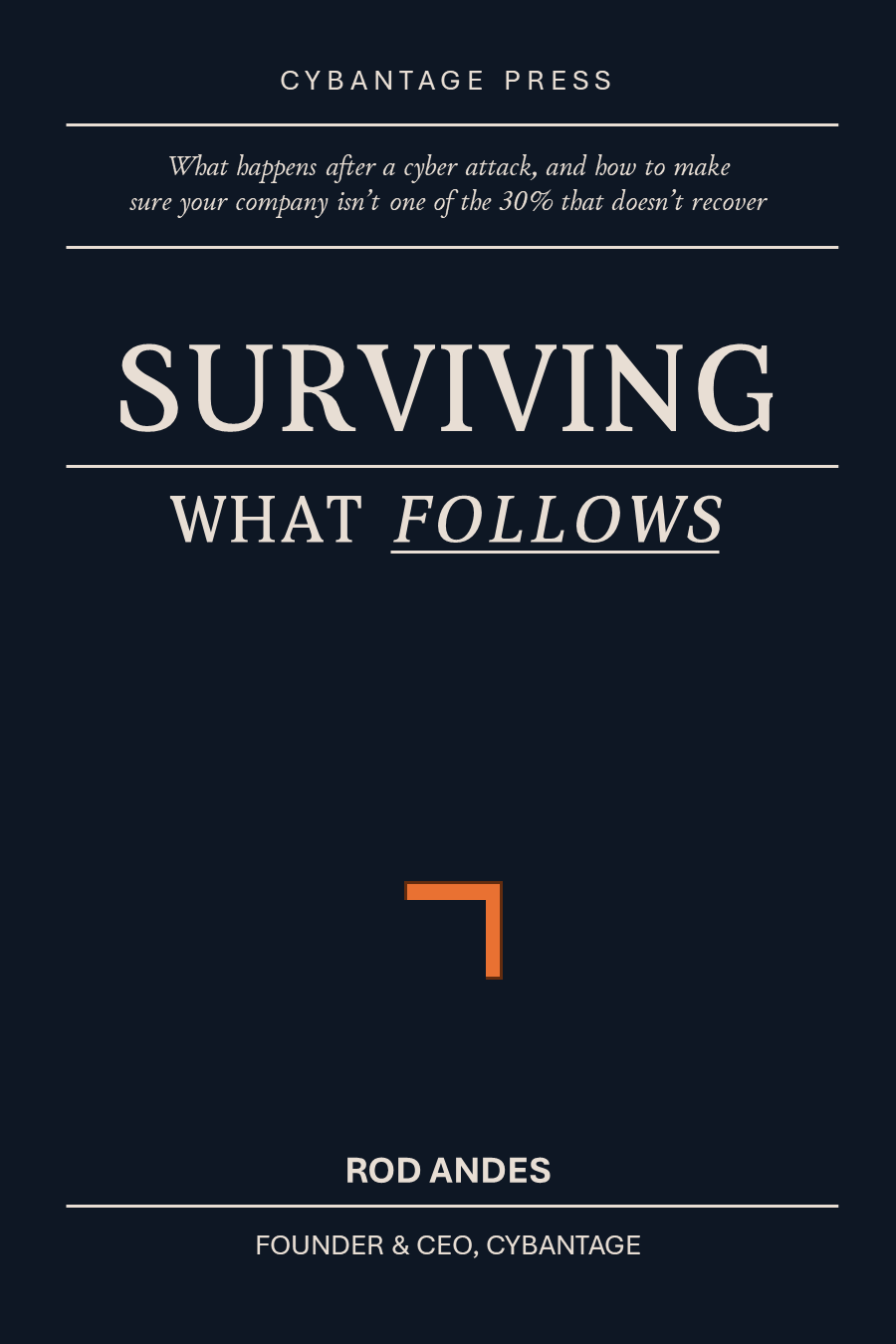
Surviving What Follows
Written for executives and security practitioners who want a practical view of what actually happens after a serious cyber event — and what must be in place before one if the organization intends to remain standing.
No cost. No paywall. Enter your information below and your copy downloads immediately.
The advisory market tells you a great deal.
This is what it leaves out.
The market for cybersecurity services is large and well-funded. There are firms that will audit your controls, certify your frameworks, assess your vulnerabilities, train your staff, and produce reports that give your board confidence that the organization has done what it was supposed to do.
What the market does not consistently address is the chain of events that follows a serious breach — the financial exposure that arrives before any insurance recovery, the governance failures that surface under the pressure of a real event, the legal exposure that accumulates in the first 72 hours when nobody is thinking about discovery, and the insurance claim that gets denied because of attestations made in an application nobody fully reviewed.
Those are not technology failures. They are architecture failures. And they happen to organizations with current certifications, trained teams, and recent audits.
The research behind this book covers 1,478 healthcare organizations and hundreds more across financial services and critical infrastructure. The patterns are consistent.
What comes to light — after the event
- After the breach Whether the organization had a designated decision authority — or whether executives spent the first hour determining who was actually in charge while the forensic clock ran.
- After the claim Whether the technical attestations made in the insurance application were accurate under forensic conditions — and whether the policy contains exclusions nobody had read.
- After the board Whether there is a defensible record of cyber oversight — or whether the board minutes reflect only compliance status reports and no substantive governance discussion.
- After counsel Whether the forensic investigation was conducted under attorney-client privilege — or whether the findings are fully discoverable and will be used in the proceedings that follow.
- After the questions Whether executives signed documents they did not review, delegated attestations they did not verify, and made risk decisions they did not formally document — and what that means personally.
Scope of Coverage
What compliance frameworks were designed to address.
Compliance frameworks serve a real purpose. The point is not that they are without value — it is that they were designed to answer a specific set of questions, and the questions that determine organizational survival after a breach are largely outside that scope.
| The Question | Compliance / Audit Addresses | Outside Compliance Scope |
|---|---|---|
| Are security controls implemented and documented? | Yes — this is the primary function of compliance frameworks | Whether those controls were operational on the day of the event |
| Does the organization meet a defined governance standard? | Yes — certification confirms adherence to the standard | Whether that standard maps to what insurers require for claims to pay |
| Were policies reviewed and approved? | Yes — policy review is a standard audit requirement | Whether those policies contain a decision authority matrix that works under crisis conditions |
| Is there an incident response plan? | Yes — IR plan existence is assessed in most frameworks | Whether the plan was practiced, whether privilege was established, and whether the notification clock is assigned to a named individual |
| Is executive leadership informed of cyber risk? | Partially — boards receive compliance status reports | Whether that reporting creates a defensible record of substantive oversight — or whether it will be characterized as checkbox governance in a derivative lawsuit |
| Will the insurance claim pay? | Not addressed — compliance and insurance are separate systems | This question is entirely outside the scope of any compliance framework. It requires a separate assessment against insurer forensic criteria. |
What the Research Shows
The data does not suggest compliance is irrelevant. It suggests it is insufficient.
Across 1,478 healthcare organizations studied and hundreds more in financial services and critical infrastructure, compliance status was not a reliable predictor of post-breach survival. What predicted survival was the architecture built around the technology — before the event.
31.3%
of breached organizations closed or were sold within eighteen months of a major cyber event. Compliance program maturity was not a distinguishing characteristic between those that survived and those that did not.
Cybantage · 1,478-org dataset · HHS/OCR 2023–2026
40–44%
of cyber insurance claims are denied at the time of loss — not disputed, denied. The denial mechanisms are specific: material misrepresentation in the application, policy exclusions, notice violations, cooperation failures. None are compliance failures.
Insurance industry data · multiple carriers · multiple loss years
~40K
average individuals affected at organizations that closed after a breach — versus approximately 194K at organizations that survived. Smaller breaches were more fatal. Scale was not the determining factor. Structure was.
Cybantage Healthcare Breach Survivability Study · 2026
"The organizations that survive a significant cyber event are not the ones with the best technology. They are the ones with the right architecture in place before the event happens. The governance architecture. The insurance posture. The legal framework. The decision authority. The forensic preparation."
— Rod Andes, Surviving What Follows, IntroductionAbout the Book
A practical view of what actually happens after.
This is not a technology book. It does not address firewall configuration or endpoint detection. Those are covered by people more technically specialized than Rod Andes.
This is a book about the organizational, legal, financial, and governance architecture that determines whether a company survives a serious cyber event — and the specific failures, in each of those categories, that most organizations are carrying right now without knowing it.
Six parts. Twenty-two chapters. Every chapter ends with specific actions — not recommendations to consider, but actual steps, actual conversations, actual documents that need to exist before the event that will test them.
"This is also an honest book. I'm going to tell you things that are uncomfortable. That your insurance policy probably won't pay. That your board is creating personal liability exposure it doesn't know about. That the compliance audit you passed last year is largely irrelevant to whether you survive a cyber event. These aren't opinions — they're findings from a dataset, and I'll show you the data."— Rod Andes, Surviving What Follows, Introduction
Part One
What Follows
The Unvarnished Reality
Part Two
The Preparation Failures
The False Assurances
The specific preparation failures that make already-serious events catastrophic. The compliance-insurance illusion. The policy your broker hasn't read. The decision vacuum that forms in the first hour of a real event. The assumption stack — the gap between what leadership believes about its own coverage and what the policy actually says. This is the diagnostic section.
Part Three · New
The Accelerants
AI Adoption & New Exposure
New in the second edition. Four chapters on the exposure most organizations have not evaluated: how AI business adoption expands the data handling surface, creates a discovery problem inside the incident, enables premature narratives that become liability, and generates compliance artifacts that describe controls that do not operationally exist. The vendor questionnaire as a legal instrument. The governance document that becomes evidence. The category of risk that governance hasn't caught up to.
Part Four
What to Build
The Architecture
The Cyber Insurance Survivability Index — 10 domains, mapped directly to insurer denial mechanisms rather than compliance frameworks. Coverage-first sequencing. The privilege architecture and how to establish it before it matters. The governance documentation package that protects executives personally. Specific. Actionable. Auditable.
Part Five
When the Call Comes
The Playbook
What to do in hour one, days three through seven, and at claim time — in sequence, with named decision authorities, and with the documentation discipline that determines whether the event becomes manageable or catastrophic. For organizations that have done the work in Part Four, this section is a checklist. For those that haven't, it is a preview of what they will wish they had built.
Part Six
Staying Ready
Maintenance
Survivability architecture decays. Policies renew. Attestations drift. Exceptions become permanent. The quarterly maintenance discipline — and the board and CISO obligations — that ensure the architecture built in Part Four remains the architecture that actually exists when the event arrives. The organizations that survive treat this as a continuous operational discipline, not a one-time project.
Free. No paywall. No obligation.
What happens after the event. Before it happens to you.
Download your free copy of Surviving What Follows and read what the advisory market rarely tells you — and what must be in place before your organization faces what follows.
Get the Free BookThe Primary Offer
Cyber Insurance Readiness Review
Cyber insurance is not preparedness. It is a contract that will be tested after the incident.
The Cyber Insurance Readiness Review determines whether your organization can prove it is doing what its policy, insurance application, security questionnaires, audits, board materials, incident response plans, and control attestations say it is doing — before a claim process tests those representations.
What the review examines
- Cyber policy conditions and coverage assumptions
- Application representations and their evidential basis
- Control attestations and supporting documentation
- IR plan alignment with carrier requirements
- Board and executive reporting quality and defensibility
- Forensic vendor readiness and consent-to-spend thresholds
- Counsel engagement structure and privilege coordination
- Carrier notice timing and notification obligations
- Business interruption documentation and recovery evidence
- Vendor dependencies and third-party claims exposure
- Gaps between documented governance and operational reality
What you walk away with
- A claim-readiness gap summary
- A representation-to-evidence map
- A cyber policy friction review
- A leadership decision-readiness assessment
- A board and executive evidence discipline review
- A prioritized remediation path
- A clear view of where claim friction is most likely to begin
Before a claim tests your evidence, test it yourself.
The issue is not whether your organization has a cyber policy. The issue is whether it can prove it did what the policy, application, questionnaires, board materials, audits, and incident response plans said it would do.